


Stéphane Braud, Color Within Color: When Pigment Becomes Its Own Subject

Updated: 22 hours ago
At first glance, the work appears to depict nothing more than an open pot of pigment.
A studio object, functional and almost commonplace. Yet beneath this apparent simplicity, contemporary artist Stéphane Braud constructs a subtle reflection on the very nature of painting itself. Presented at Ars Essentia Gallery in Beaune, this work combines decorative power with conceptual depth, inviting viewers to question what constitutes the essence of the pictorial act.

Stéphane Braud or the Art of Revealing the Extraordinary within the Ordinary
Stéphane Braud’s work belongs to a neo-pop sensibility that reappropriates everyday objects in order to reveal their symbolic significance. For several years, the artist has developed a distinctive body of work in which references to the industrial world, contemporary visual culture, and artistic materials become the subjects of paintings executed with remarkable technical mastery.
Through deliberately pared-down compositions, Braud transforms utilitarian objects into contemporary icons. His pigment pots are not merely studio containers. They become the protagonists of a reflection on painting, colour, and the production of images.
This ability to uncover the universal within the ordinary is one of the defining characteristics of his artistic practice.
Pigment as the Subject of Painting

In this composition, a metal pot filled with pigment appears isolated against a neutral background that enhances its monumental presence. The eye is immediately drawn to the luminous intensity of the colour, whose surface seems almost to vibrate beneath the effect of light.
The contrast between the purity of the pigment and the worn appearance of the container constitutes one of the work’s greatest visual strengths. The metal bears traces of labour, splashes, drips, and accumulated projections gathered over time. It preserves the memory of past gestures, while the dense and uniform pigment embodies the full potential power of colour.
The composition evokes both the contemporary still life and the sculptural object. The close framing gives the pot a striking physical presence and encourages viewers to examine the material in its finest details.
A Mise en Abyme of Painting
The true singularity of this series lies in its self-referential dimension.
The subject depicted is composed of the very same elements that make the artwork possible. The pigment contained within the pot is also the primary material used to create the painting. The metal container refers to the physical support and material vocabulary of the artist’s studio.

The painting thus presents the very materials that enable its own existence.
The pot contains the pigment.
The pigment makes painting possible.
The painting represents the pot.
This conceptual loop creates a genuine mise en abyme of the pictorial medium. The work speaks about its own fabrication. It reveals what normally remains invisible to the viewer: the fundamental components of artistic creation.
Through this approach, Stéphane Braud engages with some of the great questions of modern and contemporary art concerning the nature of representation. The painting does not tell a story external to painting itself. It reveals painting to itself.
From Warhol’s Campbell’s Soup to Braud’s Pigment Pot
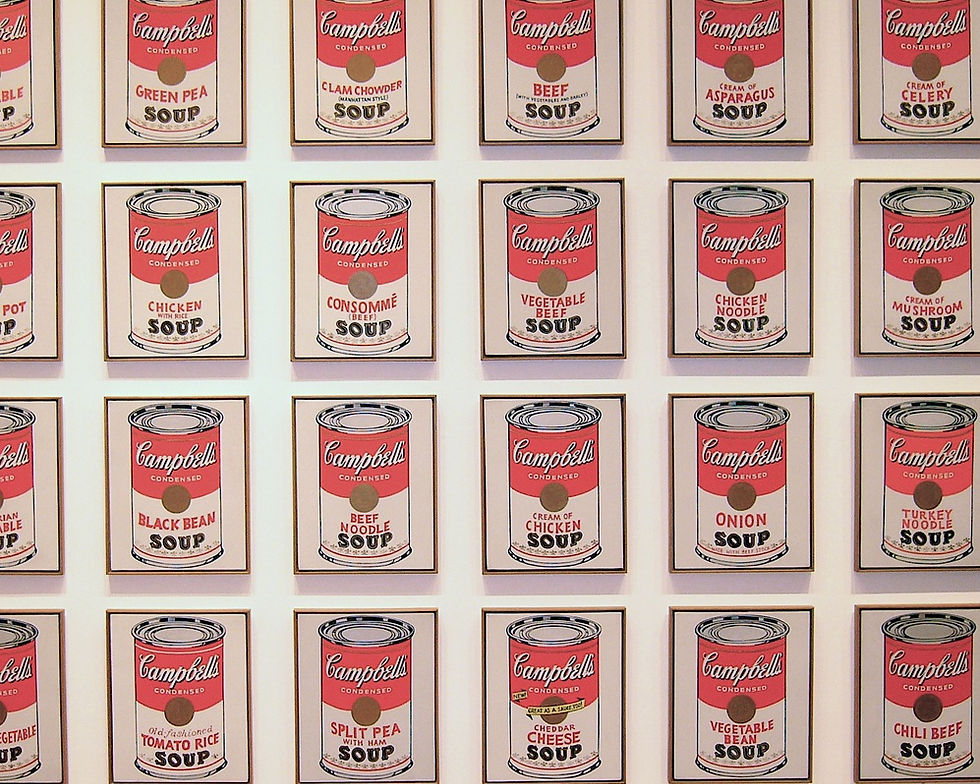
The series of pigment pots developed by Stéphane Braud naturally recalls the legacy of American Pop Art, and more specifically Andy Warhol’s famous Campbell’s Soup Cans produced in the early 1960s.
Like Warhol, Braud chooses an ordinary and instantly recognisable object. Like him, he employs repetition, chromatic variation, and the graphic power of simple forms.
However, the significance of his approach differs profoundly.
Warhol’s soup cans questioned consumer society, product standardisation, and the reproduction of images within the context of mass culture. Stéphane Braud’s pigment pots redirect this reflection toward the realm of artistic creation.
The represented object is not a product intended for consumption. It contains the raw material of the artwork itself. Where Warhol chose the symbol of an industrial society built upon consumption, Braud chooses the symbol of pictorial creation itself.
This artistic lineage enriches the interpretation of his work and firmly situates it within the contemporary extensions of the neo-pop movement. The artist adopts the aesthetics of the popular object not to question the economics of consumption, but rather the economics of creation.
The Memory of Gesture and Time
The metallic surfaces depicted by Stéphane Braud are covered with traces, splashes, and chromatic accumulations that function as archives of artistic labour.
Every splash tells a story of a gesture.
Every drip carries the memory of a past action.
Every layer of colour becomes the silent testimony of a creative process.
This dimension gives the work a particular temporal depth. The pigment appears motionless, almost suspended outside time, while the container preserves the visible marks of its history.
The viewer simultaneously contemplates the present reality of colour and the memory of artistic gesture.
A Celebration of Matter in the Digital Age

In a world saturated with dematerialised digital images, Stéphane Braud’s work powerfully reminds us that painting remains above all a physical experience.
Colour possesses a tangible density.
Matter becomes visible.
The object regains its presence.
Pigment is no longer merely a tool serving representation. It becomes the principal subject. It asserts its visual and symbolic autonomy.
Through this series, the artist celebrates one of the fundamental truths in the history of art: before becoming an image, every painting is first and foremost matter.
An Emblematic Work of Contemporary Neo-Pop
Accessible through its subject matter, captivating through its visual impact, and profound in its intellectual construction, this work perfectly illustrates the richness of contemporary neo-pop art.
Stéphane Braud transforms a trivial object into a subject of aesthetic meditation. He creates a dialogue between popular culture, conceptual reflection, and visual pleasure in a painting that continually questions the very conditions of its own existence.
The viewer discovers far more than a simple pot of pigment. They encounter a reflection on colour, creation, and the very mystery of the image itself.
Discover Stéphane Braud’s Works at Ars Essentia
Ars Essentia Gallery regularly presents the work of Stéphane Braud as part of its programme dedicated to contemporary French art. His emblematic series of pigment pots demonstrates an original artistic approach that combines decorative strength, technical mastery, and conceptual depth.
Collectors, art enthusiasts, and contemporary painting lovers can discover Stéphane Braud’s works at the gallery in Beaune or explore the available selection on the Ars Essentia website.
Through these vibrant compositions, the artist reminds us that colour is not merely a means of expression. It is also a material, a history, and sometimes even the true subject of the artwork itself.

By Cédric Le Borgne
Founder and Director of Ars Essentia Gallery


Comments