


Romano Zanotti, master of kinetic art and sensitive geometries.
Romano Zanotti, an essential figure of European kinetic art

Romano Zanotti, born in 1934 in Moio della Civitella and deceased in 2019, belongs to the generation of artists who profoundly renewed abstraction during the nineteen sixties. His work is part of the kinetic art movement, heir to futurism and geometric abstraction, which explores visual phenomena, the perception of movement and the optical effects of colour. Kinetic art is experiencing a significant revival within contemporary creation, and the rediscovery of Zanotti is fully aligned with this renewed interest in perceptual research.
An artist of Galerie Denise René and a contributor to the kinetic movement
The exhibition “Mouvement” organised in 1955 at Galerie Denise René marks the official emergence of kinetic art. Romano Zanotti was exhibited there for more than fifteen years alongside Vasarely, Soto and Agam. This long‑standing presence within a pioneering gallery of perceptual abstraction confirms his role in the European kinetic scene. He abandoned figuration at the beginning of the nineteen sixties to devote himself to perceptual abstraction centred on optical vibration, chromatic modulation and the active participation of the viewer.
The CO MO group and the construction of visual perception
In 1967, Zanotti joined the CO MO group, Constructivism and Movement, which he integrated

until 1972. This period marks a deepening of his visual language. His compositions rely on geometric progressions, chromatic spirals and circular expansions that establish a space of tension and balance. The curve becomes a central element of his vocabulary and structures perception by creating visual oscillations.
A former singer, Zanotti associated his paintings with sound phenomena. He perceived his compositions as undulations of musical notes transposed into colours and forms. This analogy between rhythm, colour and perception gives his work a sensitive dimension that goes beyond strict geometry to reach a genuine optical poetry.
A constructed, immersive and perceptual body of work
Sources highlight the extreme patience with which Zanotti developed his paintings. He considered the canvas as a space of illusion where the true nature of forms could appear. His search for pure form led him to favour stylistic clarity, constructive rigour and precise chromatic variations. His works play with light, shadow, spatial dynamics and the psychological effects of colour in order to actively engage the viewer.
This approach transforms perception into experience. Circles, chromatic progressions and optical vibrations invite the viewer into an inner movement. The work is not merely seen, it unfolds within the time of the gaze and creates a direct interaction between the pictorial surface and perception.
Exhibitions and international recognition
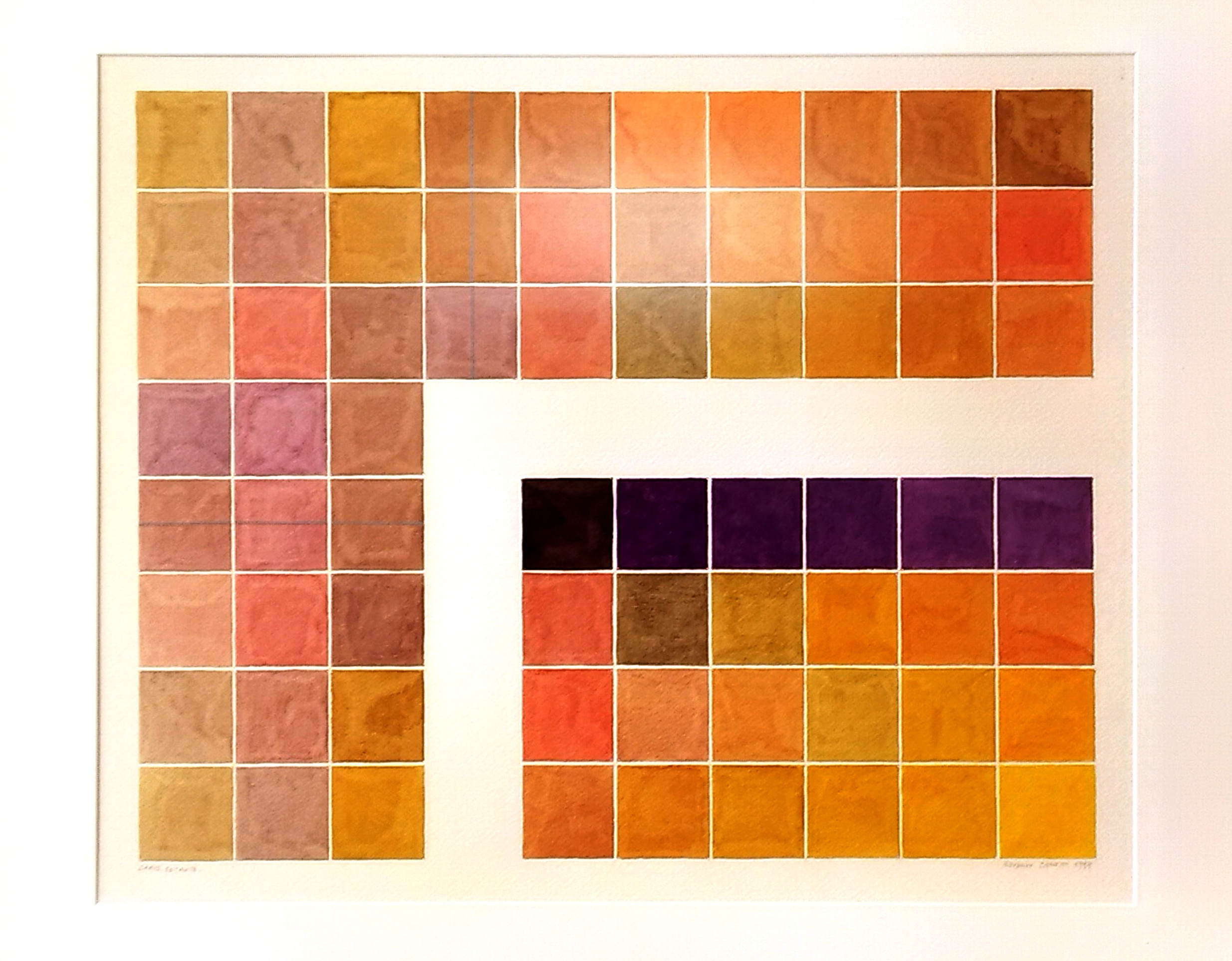
Romano Zanotti’s career is marked by numerous exhibitions in France and Europe. He participated in the Salon Réalités Nouvelles in 1969, followed by several solo exhibitions at Galerie Denise René in 1989 and 1996. He was also present at the thirteenth Quadriennale of Rome in 1999. His works were shown in major institutions such as the Centre Pompidou during the exhibition “ERRE, variations labyrinthiques” in 2011 and at the Grand Palais in “Dynamo” in 2013.
Today, his works continue to be exhibited in specialised galleries, including Ars Essentia in Beaune, which highlights his contribution to perceptual abstraction and kinetic art.
A legacy of vibration and clarity

Romano Zanotti leaves a body of work that combines formal precision and perceptual sensitivity. His paintings, based on curves, repetition and chromatic modulation, establish an active relationship between the work and the viewer. They reflect a desire to create a sensory experience in which colour and form become autonomous phenomena.
In the current context of renewed interest in kinetic art, his work appears as an essential contribution to the understanding of visual perception and sensitive geometry. It offers a vision in which constructivist rigour merges with inner vibration, where pure form becomes a space of resonance.
Copyright : Cedric LE BORGNE (Ars Essentia - Art Gallery)


Comments