


Artwork of the Month : Michel Cadoret, "Reconnaissance"

An exploration of color and materiality in lyrical abstraction
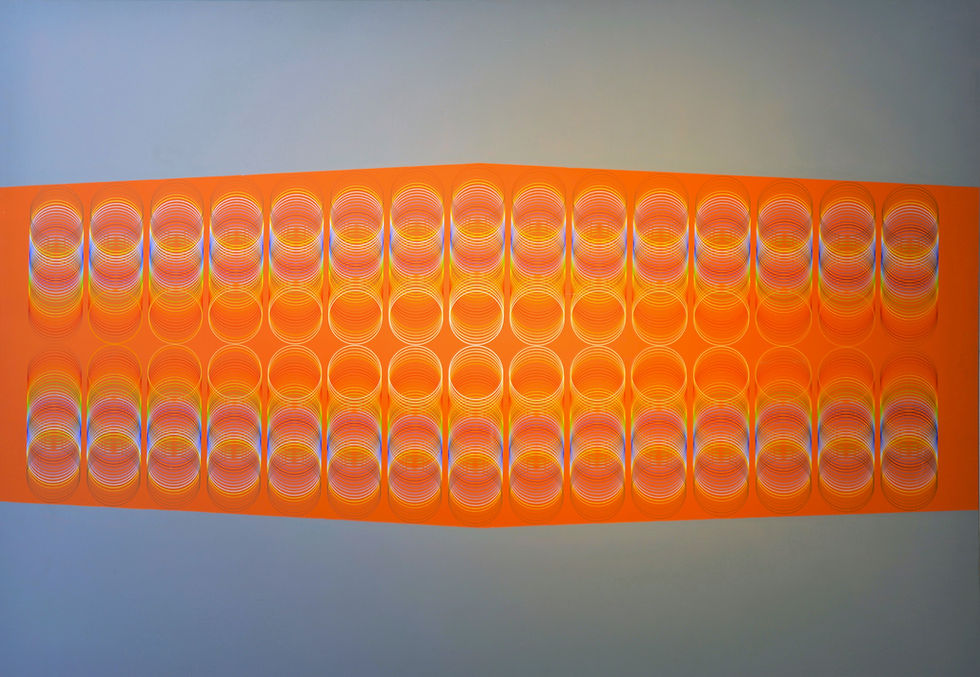
Some works do not seek to represent the visible world. Instead, they aim to translate sensations, inner rhythms, and the subtle phenomena of perception. With Reconnaissance, Michel Cadoret invites us into a universe where color becomes a language and pictorial material alone carries the full intensity of the visual experience.

This work is structured around chromatic tensions that respond to one another in a continuous movement. The forms depict no identifiable subject and resist any figurative narrative. They emerge, meet, drift apart, and merge within a space shaped by painting itself. The canvas thus becomes the setting for a sensory experience in which the eye moves freely among fields of color, transparencies, textured surfaces, and luminous vibrations.
Michel Cadoret, a distinctive figure of the Second School of Paris
Born in Paris on September 7, 1912, and passing away in Cerny on March 22, 1985, Michel Cadoret occupies a singular place in the history of postwar art. His career was shaped by extensive travel, service in the Free French Forces during the Second World War, and an artistic practice that unfolded between France, the United States, and Mexico.
After an initial figurative period during the 1930s and 1940s, his discovery of the American art scene from 1948 onward gradually led him toward abstraction. His stays in New York and Mexico proved decisive. There, he developed a visual language that ultimately abandoned representation in favor of painting grounded in the relationships between colors, rhythmic structures, and the expressive qualities of pictorial material.
This evolution established him as a noteworthy representative of Lyrical Abstraction and the Second School of Paris. His work received the support of major art critics including Jacques Lassaigne, René Huyghe, Pierre Courthion, and James Johnson Sweeney, while he associated with artists such as Alexander Calder, Marcel Duchamp, Hans Arp, and Zao Wou-Ki.
An emblematic work of Lyrical Abstraction
In Reconnaissance, the artist pursues the formal investigations that characterize his mature work. The composition is built through the interplay of dynamic color fields whose boundaries remain fluid and shifting. Light appears to emanate from within the canvas itself rather than from any external source.

This approach reflects the central concerns of Lyrical Abstraction, a movement that privileges direct expression, the spontaneity of gesture, the emotional power of color, and the freedom of form. In Cadoret's work, however, this freedom remains anchored in a rigorous organization of pictorial space. The colored masses achieve a subtle balance within a complex architecture that quietly guides the viewer's gaze.
The artist paid particular attention to the physical qualities of his materials. Influenced in part by his experiences in Mexico, his research led him to incorporate natural pigments and organic substances into his paintings, enriching the texture and depth of their surfaces. This sensitivity to the material presence of the artwork finds a particularly accomplished expression in Reconnaissance.
A Painting Between France and America
Michel Cadoret's artistic journey stands as an exceptional testimony to the exchanges between France and the United States during the 1950s and 1960s. Present on the New York art scene at a decisive moment in the history of modern art, he developed a body of work that engaged with the major currents of international abstraction while retaining a deeply personal sensibility.
This singularity explains the attention he received from the critics of his time. His chromatic investigations and his refusal of simplistic classifications resulted in a rich and multifaceted oeuvre that escapes rigid categories and retains a remarkable sense of modernity today.
A Strong and Timeless Decorative Presence

Through the richness of its color harmonies and the depth of its pictorial material, Reconnaissance possesses a particularly powerful visual presence. The work engages equally well with contemporary architecture and more classical interiors.
Whether displayed in a living room, a collector's study, a library, or a reception space, this painting acts as a natural focal point. Its abstract character opens a space for personal interpretation while bringing movement, color, and depth to its surroundings.
Why This Work Today?
At a time when images are often reduced to their descriptive or narrative function, Reconnaissance reminds us of painting's fundamental power: to offer a direct experience of color, rhythm, and materiality.
The work also reflects the growing rediscovery of major artists associated with the Second School of Paris, whose historical importance is now being reassessed. An internationally recognized figure during the 1950s and 1960s, Michel Cadoret fully deserves to reclaim his place within the history of postwar abstraction.
The Gallery's Perspective
At Ars Essentia, we were particularly drawn to the sense of freedom that radiates from this painting.

Beyond its aesthetic qualities, Reconnaissance illustrates a significant moment in Michel Cadoret's artistic journey, that of an artist who chose to trust the expressive power of color rather than the representation of reality.
The work stands as a compelling testament to the vitality of French Lyrical Abstraction and to its enduring ability to convey emotional depth and visual intensity today.
A Work for Collectors
Reconnaissance is a significant example of the work of Michel Cadoret, a leading figure of the Second School of Paris whose international career was championed by several of the most influential art critics of his time. His exceptional journey between Paris, New York, and Mexico, the quality of his formal research, and the increasing rarity of his works on the market all contribute to the artistic and heritage value of this painting.
By Cédric Le Borgne
Founder and Director of Ars Essentia Gallery
About the Artist
Michel Cadoret (1912–1985)
Full name: Michel Cadoret de l'Espineguen
Born: September 7, 1912, Paris, France
Died: March 22, 1985, Cerny, Essonne, France
Artistic movement:Lyrical Abstraction, Second School of Paris
Preferred media and techniques:Oil painting, with a particular focus on color, materiality, and pictorial rhythm
Period:Postwar Modern Art
Artistic influences and affinities:French and international abstraction, in dialogue with the contemporary explorations of Zao Wou-Ki, Hans Hartung, and Gérard Schneider
International career:France, United States, Mexico
Critics and historians who supported his work:René Huyghe, Jacques Lassaigne, Pierre Courthion, James Johnson Sweeney
Artists with whom he associated or interacted:Alexander Calder, Marcel Duchamp, Hans Arp, Zao Wou-Ki
Subject of the present work:Non-figurative abstraction based on the relationships between color, energy, and materiality
Exhibited work:Reconnaissance
Technique:Oil on canvas
Themes:Color, light, materiality, movement, emotion, and pictorial space
For collectors:A representative work from Michel Cadoret's mature period and a compelling example of French Lyrical Abstraction in the postwar era.

Comments