


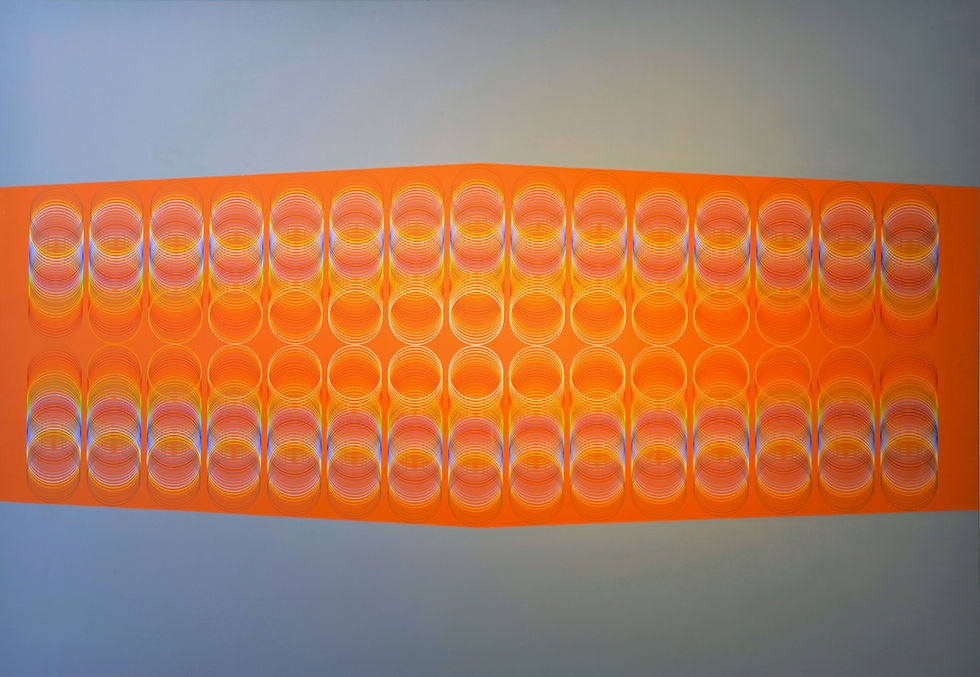
Artwork of the month : "Optical orange" by Romano Zanotti, 1967.

Updated: May 12
The Artist
Romano Zanotti is an French-Italian painter born in 1934 who played a significant role in the renewal of kinetic art at the heart of the 1960s. Exhibited for more than fifteen years at Galerie Denise René alongside Vasarely, Soto and Agam, he contributed to the development of a visual language based on perception, optical vibration and the activation of the viewer’s gaze. His career was marked in 1967 by his integration into the CO-MO group, Constructivism and Movement, which oriented his research toward a space of tension and balance where the curve became a structuring element. A former singer, Romano Zanotti perceived in his paintings the undulation of musical notes taking the form of colours and shapes that influence vision.
Historical and Aesthetic Context
Kinetic art experienced a major expansion during the 1960s, extending the research initiated by Futurism and geometric abstraction. The movement took shape after the exhibition Mouvement at Galerie Denise René in 1955, a foundational event in which Zanotti was shown alongside major figures such as Victor Vasarely, Jesús Rafael Soto and Yaacov Agam.
Kinetic art is defined by the use of light, movement and perceptual phenomena, creating a mode of composition that challenges the passivity of the spectator. Artists of this movement sought to produce dynamic optical effects that transform the pictorial surface into a field of visual energy.
Presentation of the Artwork: Optical Orange, 1967

Created in 1967, Optical Orange belongs fully to Zanotti’s most productive period, marked by his involvement in the CO-MO group. The work explores a space constructed around the curve, repetition and chromatic modulation. The composition is based
on a rigorous geometric structure in which concentric circles generate a continuous vibration that activates perception. The dominant orange colour functions as an energetic field that intensifies contrasts and reinforces the kinetic effect. The whole produces a sensation of visual undulation that echoes the musical conception the artist associated with his forms. The work sets in motion an optical dynamic that transforms the surface into a shifting space, engaging the gaze in an active trajectory.
Place within Romano Zanotti’s Oeuvre
Optical Orange illustrates the way Zanotti developed a language grounded in the tension between geometric stability and perceptual movement. The curve, omnipresent in his research, becomes here a vector of visual oscillation. The work reflects his desire to create a sensory experience in which colour and form combine to produce an autonomous optical phenomenon. It belongs to the continuity of his work from the 1960s, which associates constructivist rigour with vibratory sensitivity.
A Work of Significance for Collectors

Optical Orange represents an acquisition opportunity for any collector wishing to integrate a significant work of 1960s kinetic art into their collection. This painting reflects the maturity of Romano Zanotti at a moment when he was actively participating in the perceptual research developed around Galerie Denise René. The rigorous construction, chromatic vibration and presence of the curve give this piece a strong and immediately recognisable identity. It belongs to a sought-after historical period in which works from this movement enjoy growing interest on the market as well as within institutions, making it a relevant and lasting choice for a discerning collection.


Comments