


Bronze Sculpture: Understanding the Fascinating Technique of Lost‑Wax Casting

At ARS ESSENTIA, our contemporary art gallery dedicated to the presentation and sale of sculpture, we showcase works created using a wide variety of techniques: direct carving in wood or stone, clay modelling for ceramics, and ironwork for ferrous metals. Yet it is bronze sculpture that sparks the most curiosity. Its presence, its density, its unique patina captivate our visitors. This is why we offer a complete introduction to the lost‑wax casting technique, an ancestral process used to create most of the bronze artworks exhibited in our gallery.
What Is Bronze? A Noble and Regulated Material
Bronze is an alloy primarily composed of copper and tin. In France, regulations are strict: to be called bronze, an alloy must contain at least 65% copper, complemented by tin and sometimes aluminium to enhance hardness and resistance to corrosion.
In the field of fine‑art foundry, the copper content often exceeds this legal minimum, ensuring optimal quality for sculpture.
Since 1968, French law has also regulated the number of casts that may be produced from a single mould for a sculpture to be recognised as an original work:
8 numbered editions from 1 to 8,
4 artist’s proofs numbered I to IV.
Each cast must bear its number, the artist’s signature or mark, and the foundry stamp.

Step 1: The Original Artwork and the Creation of the Mould
Every bronze sculpture begins with an original artwork, created in clay, plaster, modelling wax, or composite materials. When the original is made of wax, there is usually only one unique model.
The first operation consists of creating a negative mould:
traditionally in plaster,
but today most often in silicone elastomer, which captures even the finest details with remarkable fidelity.
A plaster proof is often produced from this mould and kept by the artist or the foundry for future editions.
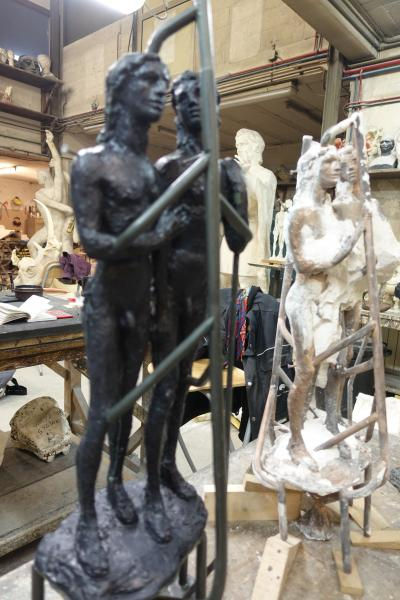
Step 2: The Wax Model
The foundry then pours several layers of wax inside the mould. For a hollow sculpture, this step determines the final thickness of the bronze and the space for the future core.
Once the wax is removed from the mould, the interior is filled with a core held in place by metal rods. The foundry then adds:
wax sprues, which will form the channels through which the bronze flows,
vents, allowing gases to escape during casting.
This stage is crucial: it determines the quality of the final cast and prevents bubbles or areas lacking metal.
Step 3: The Investment Mould
The wax model is then coated with a refractory investment mould, built up in several layers:
a very fine layer to capture details,
thicker layers for strength,
and a metal armature to withstand the pressure of molten bronze.
The mould is heated to around 700°C:
the wax melts and drains away (hence the term lost wax),
the mould hardens and becomes resistant.
It is then placed in a pit filled with dry sand to withstand the temperature rise during casting.
Step 4: Pouring the Bronze

The bronze is heated to around 1100°C in a crucible, then superheated to 1150°C to ensure perfect fluidity. The pour must be carried out in a single, steady motion, with precision and control. This spectacular and demanding step relies entirely on the expertise of the foundry artisans.
After the pour, the sculpture cools slowly inside its mould—sometimes for several hours, depending on its size.
Step 5: Release, Chasing, and Patina

Once cooled, the mould is broken open: this is the release. The raw bronze appears, still marked by the casting channels.
The following steps include:
removing excess metal,
chasing with chisels and files,
cleaning with a wire brush.
Finally comes the patina, the true aesthetic signature of bronze. Depending on the treatments applied (acids, metal oxides, ammonia vapour, heat), the sculpture may take on brown, green, or black tones, or be polished to a golden shine. A thin layer of wax is then applied to protect the surface.
Why Are Bronze Sculptures So Highly Valued?
The complexity of the lost‑wax casting technique, the rarity of limited editions, and the nobility of the material all contribute to the high value of bronze sculpture. Each piece is unique—even within the same edition—and bears the imprint of both the artist’s hand and the foundry’s craftsmanship.
This singularity is what attracts collectors and ensures the long‑term stability and desirability of bronze artworks.

Discover Bronze Sculpture at ARS ESSENTIA
If the magic of bronze speaks to you, ARS ESSENTIA is delighted to welcome you and present:
bronze sculptures by contemporary creators,
works by established and historical sculptors,
expert guidance to help you understand techniques, patinas, and editions.
Bronze sculpture is a demanding art, but also a world of beauty, material, and light. Let yourself be guided.


Comments