


Isabelle Carabantes: Instituting the Living, Reinventing Contemporary Animal Sculpture.

There are works that do more than occupy space: they reorganize it, densify it, magnetize it. The animal sculptures of Isabelle Carabantes, a major figure in contemporary bronze animalier, belong to that rare category in which matter ceases to be m
atter and becomes presence.
Born in 1965 in Paris, trained in various studios and later at the Ateliers des Beaux-Arts de Paris under Philippe Jourdain, she learned to look at the world not as a backdrop but as a vibrating organism, traversed by tensions, forces, and silences. Very early on, she understood that sculpture is not a matter of reproduction but of presence. Isabelle Carabantes grasped from the outset that
animal sculpture is not an art of imitation but an art of revelation. She does not seek to reproduce the animal: she seeks to institute it, to restore its sovereignty within the visible.
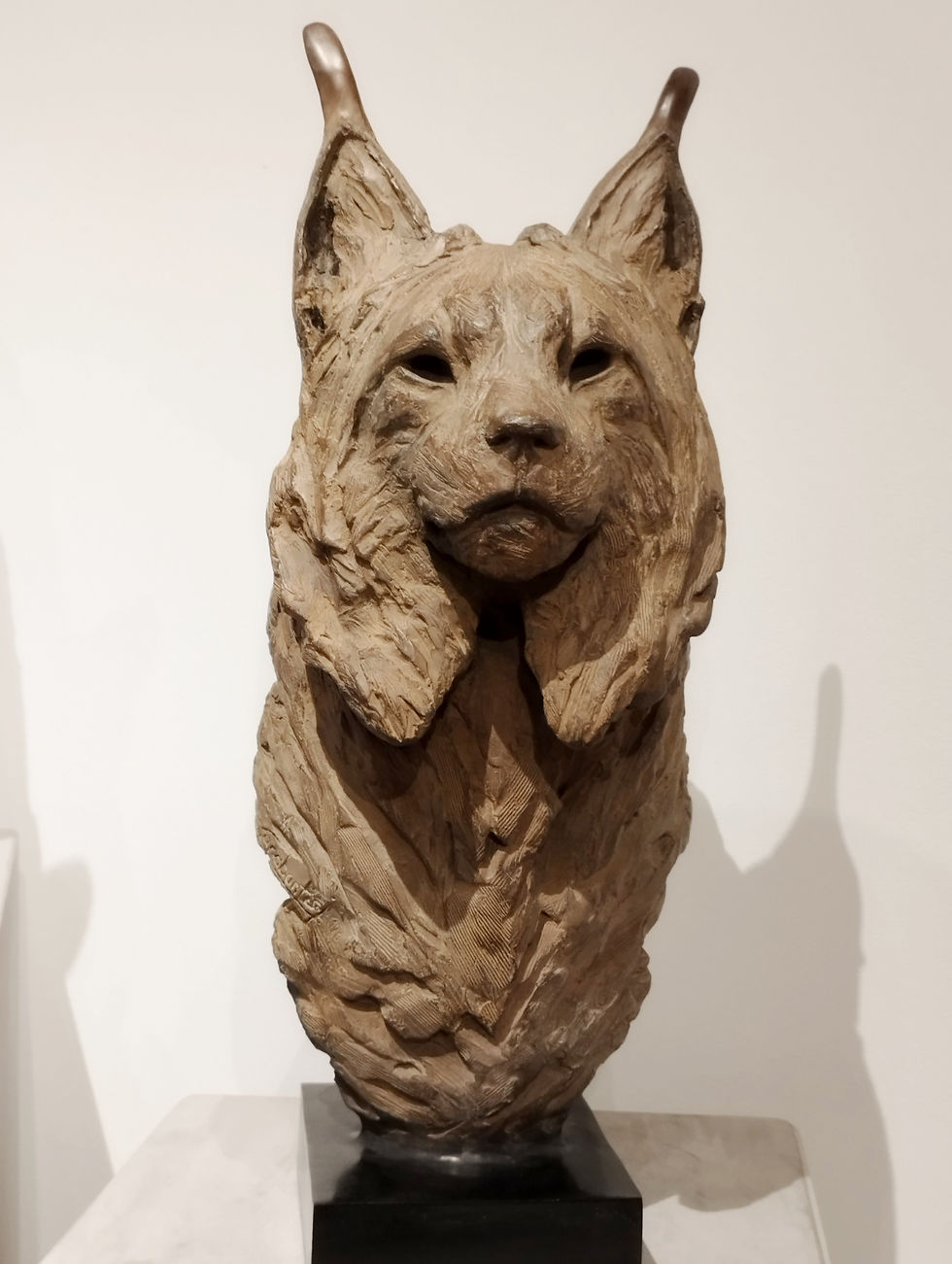
Her gesture—precise, taut, almost ascetic—aims to convey the living aspect of animals. Not merely their anatomy, but the internal tension that animates them, the vibration that precedes movement, the impulse that rises beneath the skin. In her bronze sculptures, the material is never fixed: it remains porous, traversed by forces, charged with an energy that seems still to circulate.
One reads in them the trace of modelling, like a held breath. This expressive, almost telluric materiality gives each piece a presence that is not only plastic but nearly metaphysical — a rare signature in the field of bronze animal sculpture.
A Demanding Lineage: Rembrandt Bugatti, Paul Jouve, Rosa Bonheur — and the Continuity of the Living
Isabelle Carabantes’ work stands within a prestigious genealogy of animal art. One recognizes the luminous shadow of Rembrandt Bugatti, the absolute master of bronze animal sculpture, whose big cats at the Jardin des Plantes seemed to breathe through still-warm wax. Like him, Isabelle Carabantes captures the solitude, nobility, and secret fragility of animals — that inverted humanity lodged in their gaze.
From Paul Jouve, she inherits a sense of rhythm, of inner monumentality, of that capacity to make each animal an architecture of forces, an edifice of light and tension. Jouve, a towering figure of twentieth‑century animal art, saw in every feline a living cathedral; Isabelle Carabantes extends this vision into contemporary bronze.
But another presence, closer still, watches silently over her work: that of Rosa Bonheur.

Just a few kilometres from Isabelle Carabantes’ studio stands the Château de By-Thomery, where Rosa Bonheur lived for forty years, surrounded by her animals, in a studio bathed in an almost sacred light. There, the great nineteenth‑century animal painter pursued tirelessly the quest for truth, for life, for the animal soul apprehended in its primal dignity.
Between Rosa Bonheur and Isabelle Carabantes, the kinship is profound: the same attention to gesture, the same respect for the model, the same desire to convey not appearance but inner truth.
In contemporary bronze animal sculpture, Isabelle Carabantes continues what Rosa Bonheur sought in painting: a phenomenology of the living, a way of bringing forth the animal as subject, as presence, as sovereign otherness.
The Inhabited Bestiary: Sculpture as a Territory of the Living

The works of Isabelle Carabantes — Cheetah Head, Panther Fragment, Caracal, Gorilla, Polar Bear, Buffalo, Eagle, Lioness — are not portraits but encounters.
They impose an almost physical presence: one feels the weight of the buffalo, the tension of the feline, the gravity of the primate. Each sculpture seems inhabited by an inner force, as if the animal were holding back its movement, ready to spring forward or vanish.
This density, this energetic charge, gives her work and her sculpted bestiary an almost ritual
dimension: the animal is no longer motif but totem, no longer subject but interlocutor. In the field of animal sculpture, few artists manage to produce such intensity of presence.
Carabantes’ bronze animal sculptures travel — in France, Belgium, the United Kingdom — exhibited in demanding galleries and prestigious salons. They assert themselves through their strength, their density, their ability to reactivate an archaic relationship with the living.
An Aesthetics of Presence: Sculpture as Experience
In a world saturated with rapid images, Isabelle Carabantes’ work imposes another mode of looking: a gaze that lingers, that listens, that recognizes in the animal not an object but an alter ego, a visitor, a messenger.
Her sculptures do not merely occupy space: they reconfigure it, magnetize it, densify it. They remind us that bronze animal sculpture is an art of presence, an art of resistance, an art of light.
Isabelle Carabantes does not show the living: she reveals it.
She makes it an experience, a meeting, a truth.
And within that truth, something of the legacy of Rembrandt Bugatti, Paul Jouve, Rosa Bonheur — and perhaps even Baudelaire, when he evoked “modern life” and its revelations — continues to
.
Isabelle Carabantes: An Essential Voice in Contemporary Bronze Animal Sculpture
At a time when animal sculpture is experiencing an international revival, the work of Isabelle Carabantes stands out as one of the most singular and powerful.
She seeks neither effect nor gratuitous virtuosity: she seeks presence, truth, breath.
Her bronze animal sculptures are not objects: they are beings, presences, fragments of world.
In an artistic landscape often dominated by abstraction or concept, Isabelle Carabantes reminds us that figuration — when inhabited, embodied, transfigured — remains one of the most intense sites of aesthetic experience.


Comments